Friday, September 9, 2011

Elementary School Textbooks

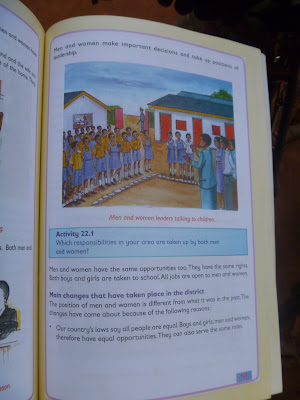
The elementary school students showed me their new books they waited most of the school year to read. Here are excerpts. Sorry they are so small.

The section on child abuse lists one cause of child abuse as "indiscipline among some children who may be stubborn." A bit disappointed with this, but it's balanced with an image a child being hit with a stick, meant to represent one form of child abuse - a tactic the school in Rubona most certainly uses, as I wrote about earlier.

There is a section on the importance of good roads, which is very Rwandan.


There is also a nod to women's rights and equality, though the use of present tense - stating that women are now equal to men, as if there is no room for improvement - can be frustrating. Women's Day in Rwanda seemed to be all about how Rwanda has reached equality, and the elementary school textbooks are similar in this regard. This may be a good tactic, though - kids might be more likely to act a certain way if they think others are already acting that way.


There is a nice picture of a modern super market placed next to a picture of a traditional market. The super market is Nakumat, and is one of only two in the country, as far as I know. It's looks very organized, though empty, in the photo, and everything looks so easy to find next to the photo of the rural market. There is no mention of the fact that prices are about ten times as high in the super market, but I suppose these are nine year olds reading the book.

I liked the sentence "peace is affected when people engage in fighting." A bit circular, isn't it?

But this is for elementary school children, so alright.
The photo of the girl and boy riding their bikes seems a little inaccurate, because girls almost never ride bikes and are even less likely to have long hair, as it's not allowed in school. Though maybe it's the image of a brighter future for girl bike riders. I have noticed that boys not only are the ones who can ride a bike without social stigma, but they also get to ride on the back of their friends' bikes. It seems so unfair that girls walk in groups and boys ride their bikes in groups, getting home so much faster - something that leads to them staying in school for longer. One girl who helped me translate at a local seamstress also likes to ride a bike - or so I've been told. This fact came up in the local gossip, because a girl riding a bike is a big deal. She also whistles, which girls don't do, and plays football. Sometimes I whistle and people tell me I can't, because I'm a woman. And not a male cowboy, the typical whistlers.

Tuesday, August 30, 2011

One Laptop Per Child in Rubona

Dativa's snack shop's table had two One Laptop Per Child laptops casually lying around in their plastic wrappers, with two small children sitting near them, munching on amandazis (donuts). It is really weird seeing children in rural areas, some with only one torn warn uniform they wear daily, carrying brightly colored laptops.

I tried to help some of the teachers learn how to use the laptops. This thing is, I'm really lost using Apples because they're not PC's, so forget about a totally different "user friendly" operating system. I suppose it may be user friendly, but Windows is just etched into my brain. So most of my "helping" was my usual, "oh no, what did I press? no, no, bring the window back, bring it back" followed by the teacher I am helping pressing a few buttons and bringing the window back, even though the teacher has close to no experience using computers, and then both of us realizing I am only there for moral support. And me also realizing that even with my 20+ years experience using computers, I am still about as good or worse at using them compared to a grown adult clicking away at the keys for the first time.

I did teach him how to save a text document. Yay.

Both of us could just not figure out how to find the flash on the computer after plugging it in. Which is a shame, because flashes are the only way to share anything around here, where internet non-existent or to slow for Dropbox.

The kids are supposed to get internet soon, and then they can use wikipedia. The teacher I was helping was extremely excited about this - the idea of being able to search for anything under the sun and get some sort of answer. I told the teacher he could even add information he knows.

I don't yet know how they are going to integrate the computers into the classroom, but I will keep you all updated. Maybe with a One Laptop Per Child laptop.


Sunday, August 28, 2011

Theological Asides from Bank Tellers

For a few weeks I used my Israeli passport because my US one was on an adventure searching for a visa. "Ah, you are from Israel!" was the reply I got from workers in various public and private institutions. "So, you believe in Jesus and accept him as your savior?" they add as an aside, casually, sometimes before adding, "and how's the weather over there?"

I pause and say, "Well, I am Jewish, so...no" and I pause, knowing my answer may have offended them more than their question offended me, and add "butIhaveseenwherehewalkedonwater!" quickly, hoping the last statement will make up for any perceived failings on my part. Most of the time, people think it is absolutely hilarious and confusing that I do not believe in Jesus, but I think it's absolutely hilarious and confusing when bank tellers, school administrators, and shop keepers ask me this immediately after finding out I am from Israel.

After I give my answer, I am assured I will be prayed for and someday I will believe him (Him?)

Which I suppose, given the honest asker's theology, is the best answer I can expect.

I'm back to using my US passport, so now bank tellers just yawn and ask me to please sign here.


Monday, August 22, 2011

Chance to clutch

I went to two fabulous weddings, fabulous in their own way. One was of a colleague at ASYV and another was a cousin of a colleague at ASYV. I did not go to the traditional Rwandan dowry ceremony, so I will focus on the wedding bit - the part that is overwhelmingly influenced by Christian weddings in the West, but with nice Rwandan twists.

But first, off to the salon.

Before the wedding I was in a salon - or "saloon" as everyone writes in Rwanda - looking at all the pretty ladies and gents get all dolled and Kenned up. And it dawned on me: every stylist in the world, when not attending to celebrities or women over forty, does the Prom Look for at least half their clients attending some event. A friend in Jerusalem warned me about this before my brother and sister's weddings. Don't-get-the-prom-look. The prom look is the ten bucks hair style where you straiten out the hair one lock at a time, then curl it with a curling iron, then put all the hair up, and then spray half a bottle of super-hold hair spray. And it has reached Rwanda. One aerosol can at a time.

I think my favorite part about Rwandan weddings is that everything is a ceremony. When it comes to cutting the cake, the MC says, out loud, that the cake will now be cut, that the groom will now give a bite of the cake to the bride, that the bride will now give a bite of the cake to the groom, that the bride and groom, or someone, will now cut the cake and distribute it to guests.

The MC is very important.

One of the kids stories I read at ASYV had a scene where the groom wanted to thank the formerly evil step parents for everything they did for him, after they stopped being evil. He asks the MC, "May I now give a speech?" and the MC gives him specific permission. So he gives a speech. And reading the story, I'm thinking, "Really? On your own wedding day you need to ask the MC first?"

The dancing industry is quite strong in Rwanda. Many people who can afford it hire dance troops to perform at their weddings, including traditional Rwandan dances, and, in the wedding I attended, Burundian and South African dancers. There is no dance floor for the guests, so everyone just gets to watch dancers that know how to dance. No awkward, "C'mon, come dance, c'maaaaaan!" in Rwandan weddings. Just rows and rows of guests sitting, looking at the bride and groom who sit above everyone, importantly, and watch the dancers and speakers along with everyone else.

At one point in the speech of the preacher of one of the weddings, I was told that Europeans don't quite understand marriage, with their high divorce rates. Women, the preacher said, will divorce their husbands and still be supported by them, so women will get married many times to get supported by many men. This was a bit depressing to hear in a country where many women receive no support by the father of their children, but my offense turned into amusement when he noted that, in European families, the dog is more important then the child. But then I was offended again when he said that the child was more important than the woman, who was more important than the husband, and so, in Europe, all is backward because the husband, really, should lead. Ah - and I was not sure if I should be offended or incredulous or amused or guardedly apathetic when he said that men want honor but women want financial support. "Some women want honor, because some women are like men. But they are a small minority compared to the men who want honor."

Finally, a nod to Israel: the bride and groom were advised to take time off after they married. The bible instructs one to not go to war after getting married. In Israel, it is not possible to take a vacation after getting married, because there is always a war and so everyone must always fight, all the time. But that is not the case in Rwanda.

Huh.

And then, the last statement I feel sums up where Rwanda is right now: "Even when the woman has a higher salary than the man, she wants the man to financially support her." In a country with a strong push towards women's empowerment, many women do, indeed, have a higher salary than their husbands. I am happy that I am in a country where the qualification "even if the woman has a higher salary" is put before statements I wish were not said.

The bride's were stunning and the grooms hansom in both weddings. No prom hair. Beautiful.

As were the flickering Christmas lights coiled around the table where the bride and groom sat. I like them. I dunno. They're sparkly and flashy and, in a culture with lots of long speeches, a great diversion for everyone who doesn't really know the bride and groom. Maybe all wedding everywhere have seemingly long speeches if you don't know the bride and groom, and in Rwanda, you are more likely to be invited to a wedding of someone you don't really know.

I also got to use my gold clutch twice.

Ah, and my white stilettos because the owner of the shop where I left the white stilettos returned them to me.

As the father of the groom was given a very serious, moving speech, the pool party outside, in the same hotel, was playing songs my Ms. Jojo, Tom Close (if you miss N'SYNC) and, of course, Celine Dion, because Celine Dion has reached every single country in the entire world and every single country loves Celine Dion. And Beyonce.

Another nice diversion.

That's not nice.

But I couldn't really understand the speech.
All in all, as I clutched my clutch, I enjoyed both weddings immensely.


Thursday, August 18, 2011

Crime: Inside versus Outside

Rwanda is one of the countries with the lowest rates of street crime in the world, comparable to Japan as of 2003, and still "really low" according to this (Ann Arbor Chronicle), this (UK government), this (Ireland's Department of Foreign Affairs), this (New York Times) and this article (ok, the government newspaper The New Times, which doesn't quite count). According to Interpol in one UNODC document, homicide rates are lower than in the North America. Yet Rwanda also has one of the highest rates of domestic violence in the world. The World Health Organization, which may be more likely to take into account unreported suspected murders committed in private, puts the homicide rate at four times as high as Interpol.

This odd combination of safety outside and danger inside is felt.

Street theft is incredibly low. Insanely low. People won't even let you let them steal things. As someone who loses things all the time, I have had strangers run after me, returning my wallet, cell phone, loose change that has fallen out, and an x-ray from King Faisal Hospital that I left at a small grocery store registry. Just four days ago, I had a fabulous outfit for a wedding in a bag that I left in a tiny milk shop, whose monthly profit is almost definitely not more than around 30,000 francs a month, based on the interviews I conducting with surrounding milk shops. The clothes and shoes in that bag, including white stiletto heals (yes, I brought those from Israel), a tailored shirt, and a nice black dress skirt, were probably worth the equivalent of at least one month's income for this man. As I got on the bus, the shop owner ran after me, just in time, to return the wedding outfit, saving me from social mortification inherent in being under-dressed in Rwanda. People yell "ssssssss!" to grab people's attention, and when I hear the familiar "sssssssss!" I usually end up looking back to someone who is waving my latest lost item, waiting for me to go back and get it.

Every time I lose something, the returner says, "You are very lucky, if it was someone else..." followed by a laugh reserved for absent-minded blonds. But it seems that I would have been just as lucky with everyone else.

Sometimes strangers will accompany me on the way home in Rubona. At first, I was sure there was some ulterior motive - money, hitting on me, curiosity, or maybe boredom. But I quickly learned that, if you are walking alone, people will just walk with you, to make sure you are not lonely or feel unsafe. They do this for other people as well, everyone from old women to young toddlers, so it is not just because I am a foreigner.

A few hours ago I did my daily accidental trip over a crack in the sidewalk. A lady walking by gave me a side glance and said, "oooh, sorry." Strangers in both the cities and the villages often say "sorry" when you trip, fall, or drop something. And nobody knows this more than me.

I am a woman who has always, throughout my life, taken the decision to walk home at night by myself both out of principal, impatience and a love for listening to Alanis and Mika while walking alone. After living in Israel, where I have been harassed and even assaulted a number of times, I can tell you that walking around Rwanda I feel as safe walking home as I do walking around at home.

I have talked to young women in Kigali and Rwamagana who like dressing up and showing a little skin, and they tell me that it's all about walking confidently on the street and ignoring the stares. "It's all about walking confidently" is something you cannot say in crime-ridden streets. Confidence, despite what Cosmopolitan tells you, is pretty useless in a lot of places, like East Jerusalem and Harlem in the 1990s. And when I considered walking confidently, at 5:00am, to a taxy fifty meters from my guest house in Entebbe, I was told that I absolutely would be mugged or worse.

In Rwanda, I have noticed that people even return small change to me that I have dropped, that I clearly will not notice is gone - a 10 franc coin, which is hardly anything even by Rwandan standards. Perhaps they return the small change because it hardly amounts to anything, anyways, and the large amounts to avoid being accused of theft. But even if this is the logic, the logic is the mechanism for a very admirable cultural norm.

In public, trust seems to be incredibly high. Neighbors help each other out, personal space on public transportation is non-existent, strangers return lost wallets, the money in tact, and women walk around, alone, at night. Compared to other countries, crime is low.

Outside the house.

Inside, it's a different story.

I have met numerous women who were sexually abused indoors, whether in their homes or indoor public locations, such as bars and schools. Child molestation, rape, and abuse is common. Some people don't seem to be aware that, when the boy is not an adult, it is still rape if the boy forces a girl to have sex. There are many cases of older men sexually abusing girls, including small children, that they financially support, as I wrote in an earlier blog post. Sexual abuse of students by teachers occurs, as well. One former teacher, who is now an unemployed alcoholic roaming the streets of Rubona, told me he needed to stop teaching when he got married because the female students "always wanted to have sex with him." The Light in Our Home project from the NGO Global Grassroots writes about the issue of sexual abuse in schools in Ruhango Sector. One excellent study published with UNICEF and the Rwandan National Youth Council discusses the attitudes of children and teachers regarding violence against children, both in and around schools.

On the first week in Rwanda I heard a child screaming out for help inside a bar that was located less than a meter in front of homes. The police came asking questions soon after.

The average night club seems to be as disturbing as the seediest clubs in other countries.

A man once shook my hand in a club, and refused to let go. He started tightening his hand around my wrist until I felt like it was literally about to break. I tried to pull away but he just tightened his grip until I protested loudly. The man next to him, an American businessman, started to laugh. I started to yell louder until others looked our way and he finally let go.

One club has a special drawer in their back room, reserved for passports that are discarded by thieves who steal wallets. The fact that there is a drawer for passports suggests that crime is not particularly organized. In Barundi on ASYV staff member had her passport stolen with the gang calling her up and asking for money. Passports in other East African countries are worth a lot, as they are manipulated and sold in an organized black market which does not seem to exist in Rwanda.

Some claim that low levels of public street crime is due to the tough stance of the government against crime, or the high quality of the police force. It is fear of the police, not exactly trust of others. This definitely is part of it. But I really think that not stealing in public and returning what is not yours is something deeply rooted in Rwandan culture.

There has been much discussion on the rising levels of theft and violence that occurred even before the genocide, which would suggest that the post-1994 government had something to do with the current low crime rate. You might have read Jared Diamond's take (you can read an excerpt from Collapse: How Societies Choose to Fail or Succeed here). He points out that "even before 1994, Rwanda was experiencing rising levels of violence and theft, perpetuated especially by hungry landless people without off-farm income." However, it may be that crime before the poverty that rose in the late 1980s was always relatively low. One Encyclopedia by from 1987 by George Thomas Kurian notes that, "Data concerning crime are not available, but law enforcement problems are believed to be minor." You can read a snippet here.

When the crime does not directly harm another person, such as narcotics, it's not as low. The Rwandan police reports have noted this: drugs use is on the rise. If crime is low from people helping people who want to be helped, then this really would not help those who are addicted to drugs. After two volunteers returned from Kenya and told me about the widespread glue-sniffing of street children there, I started to notice the street children in Kigali sniffing glue, the bottles up their sleeves or in brown paper bags. They were around the center of town, where there is a heavy police presence. Women still sell clothes illegally on the street, and have become excellent sprinters, running from the police, taxes, and potential fines and prison sentences. When I see police running after them, they need to run incredibly fast, and often can't keep up. If other crimes that don't directly harm others are still widely found, it may not be fear of police alone.

I hope, one day, the rate of domestic crime and violence is as low as street crime.


Sunday, August 14, 2011

Quality Control in the Milk Industry

I cracked open another carton of Ikivuguto. Or butter milk. Or fermented milk. Either way, it was spoiled. The third time in a month. Despite the strong push to encourage quality-assurance through factory made butter milk, the cartons that come in matching colors and labels have proved a disappointment. Part of the problem is that apathetic store owners don't bother to take down the spoiled milk from their shelves. Small business owners who only sell milk in large jugs fermented at home, along with tea and donuts, will not hesitate to tell you, "I would serve you the milk, but it's gone bad." They know that, with strong competition and not much else to offer, spoiled milk can mean one less regular customer. Rwandan fermented milk shop owners may not serve with a fake smile, forced "how are you?" and top-notch customer service, but they will not serve you spoiled milk. It might be a bit warm at times, but still drinkable.

Walking through Nakumat, the multinational super market chain store that be found in other major East African cities, I came across ten cartons of fermented milk that were part of the same shipment that carried the spoiled milk I had bought two weeks ago. And a week before that. "How can I help you?" a store worker asked me. "This is not good, right?" I asked him, pointing to the milk. He did no understand me for a moment, and said, "Yet, it is milk," and started to hand me a carton to buy. I looked at the milk and looked at him with a nervous expression. "It is old, isn't it?"

He shook his head and responded with, "Yes, it is three weeks old. It is not good. We will get more later." He did not think to take the cartons off the shelf. After all, he only worked there. They lay there, ready for more customers to buy them and not drink them once they were opened.

One reason that quality assurance does not have such an added-value is that there seems to be, in general, a high level of public trust. Which I already wrote about in an earlier post. People who own shops will tell you if their milk is bad. Walking back home with my family, when they were here visiting, we stopped at a shop of a woman who had waved to us an hour earlier. She had a genuine smile and seemed happy when we came by her shop. I asked for milk. She nodded and told her friend, who translated from English, that the milk was a bit old and not fresh enough to be served.

If individual shop owners are not out to rip you off, then you can assume, to an extent, that the product will be decent, and quality assurance is not as necessary. If quality assurance was just an extra precaution, I would be all for it, but it seems to often be mutually exclusive with individual shop owners taking precautions to assure quality goods. If you have a brand you can complain to about spoiled milk, the buck is passed to a large company, and the individual shop owner is not blamed. Some small fermented milk shop owners also serve long-lasting milk, produced by one the two large factories, and their milk is sometimes bad. It's honestly hard to blame them.

With their own locally produced milk, you literally see them pouring the large jug into a smaller jug, and can see the texture of the milk, smell it if you try, and even have a taste, just to be sure. You can't "have a taste" with a closed carton, or even see if the milk is really chunky.

And no matter how much you think fermented milk is icky, it's nowhere as icky as chunky milk from a long-lasting milk carton that you just opened.

Don't get me wrong: I think the existence of long-lasting milk throughout Rwanda is excellent, and quality controlled factory long-lasting milk is necessary. I just don't see the need to have fermented milk, which lasts longer than non-long-lasting fresh milk, put under the same centralized quality control. The sharp competition, with ten fermented milk shops within a one kilometer radius is some parts, combined with general public honesty about goods sold, does the job.

Saturday, August 13, 2011

Monocrops Far From the Main Road

I got on the back of a seemingly comfy pillowy mattress-like motorcycle taxi seat. Over ten-kilometers later, I realized the fluffyness was an attempt to make up for the most painful, bumpy moto ride I have had yet, down and up incredibly rocky dirt roads built by chance rather than engineers. I was bumping up and down, in the air at times. There was a miniscule bar in the back to hold on to with one hand, the only means of staying on the bike.

When I got to the other end, I met a woman who, nine months earlier, had given birth moments after riding such a motorcycle ten kilometers in the other direction to the nearest clinic. The baby had started pushing its way out as she was riding on the back of the moto.

She lives in a place where buffalo run around. We saw one being chased by a dog. The buffalo won, and the dog was seen slowly trotting back home. The closest neighbor is around fifty meters away, fairly far for Rwanda, which has a high population density.

Outside, the grass is mostly not green, but a light beige, in contrast to more fertile areas only kilometers away.

They live near a swamp. A recent law bans the growing of traditional crops, such as cassava and potatoes, in the swamp area. Instead, all plant rice in this area on the small plot of land, roughly 40 by 50 meters, allocated to each family.

Cooperatives of around six to ten members sell the seeds to the farmers, who grow rice and sell the rice back to the cooperatives for 230 francs a kilo, the price after the deduction for the seeds. Around 100 kilos is expected to be grown each month for a profit of 23,000 francs a month.

Nobody quite knows if the rice will grow and what they will do if it does not.

This is clearly a government-mandated, not market-oriented, approach. The commentary on this policy has been, in many circles, quite critical, such as this article by Manuel Milz.

The only defense of the policy I can think of: with very limited land resources, and a need to provide nutrition for the population to assure healthy people and lower medical costs for the government, it's necessary to utilize the land the best way possible. If there is a swamp area that can grow rice very well, and another area that can grow beans very well, and a country lacking in nutrition that only these crops can provide, it makes sense to require harvesting those crops in those areas. Healthcare is not market-oriented, it is provided by the government; so to cut costs in health, it is necessary to alter the market in favor of eating healthy things.

However, if rice really can produce a greater profit as the government claims, then farmers will choose to grow rice. If they do not choose to grow rice because of the risks, but the government mandates that the long-term profits and health benefits as a whole will outweigh any individual economic and health risks, then the risk should not fall on the individual farmers without their consent.

But this is all classic, old news: my biggest concern is with the cooperatives.

The cooperative purchasing rice in this area are registered for the government. I was told they needed to do this "in order to get the ok" to buy the rice. If there is any bureaucracy involved in creating the body necessary to sell seeds and buy back the products, that creates even less competition in the market. Cooperatives are an excellent way to promote transport and resale of goods, but if there are laws limiting what farmers can produce, there should at least be plenty of multiple buyers so the farmers have some sort of negotiating power.

The distance from the main road and the expense of getting there means farmers can hardly compare different markets and find the market willing to pay the highest price. Multiple cooperatives approaching the farmers could mean a more fair price. And by "fair" I mean enough to live on.

Because the distance also means additional jobs to supplement farming are difficult to come by. Primary school teachers also make only 24,000 francs a month, but if you are teaching and farm, the total income is more than the equivalent of 24,000 francs a month.

To make matter worse, the low population density and distance from the main road means there is no lower secondary school where students can improve their job prospects, and eventually leave the area.

This particular family has chickens. They wobble in and out of the house, attempting to squeeze their feathery bodies under doorways to reach smaller rooms where they can lay their eggs in private, with around ten eggs total laid each day. "ssshhhhhh!" family members yelled at the chickens until they ran outside the house, wandering back in moments later. The eggs, at least, provide some protein.

While the agriculture on the outside and prospects for the future are uncertain, the inside of the family's house had a sturdy furniture and the best interior design the family could come up with, given the circumstances. The floor, covered with a traditional straw mat, is very flat because the dirt is mixed with cow-dung, which hardens the ground. It also attracts thousands of flies, tempted by the cow dung only they can smell, but forever blocked by the straw mat. The flies fly upwards to the food at meal time.

The insects contrast sharply with the careful, almost Victorian set up, with a complete living room set of couch and three arm chairs with comfortable pillows, all surrounding a nice, wooden stylized coffee table. Over the back pillows lie little ivory-colored embroidered cloth napkins which match the curtains hung over every door way, themselves also embroidered with pastel flowers - nothing too bright, quite subtle, very tasteful. The coffee table has a matching cloth napkin under a vase filled with plastic flowers. The cow-dung really does create a very flat, hard dirt floor under the smooth mat. If you are wearing heals, they make a clicking sound.

If I took a picture and Photoshopped out the flies and multiple wasp nests in the corners, it could really be something from Martha Stewart. Or at least Ikea.

I put the baby almost born on a motorcycle on my lap. "No, don't hold it, he will urinate on you," I was warned. Just in time, I picked the baby up and quickly placed it on the floor. "Do you use diapers?" I asked. "They are too expensive. Soap is expensive."

Soap is expensive in the area because it is far from the main road, an extra 200 francs (roughly $33 more) so babies clothes are changed if they have an accident, rather than their diapers.

The motorcycles picking us up were late by three hours, despite calling to remind them.

"I will tell them we will take another moto."

That, clearly, did not speed things up because there are no other motos.

Even if children do find the energy in them to walk twenty kilometers a day to the nearest secondary school, the school is a private one, so most cannot afford the 300,000 francs ($500) a year school fees. The local primary school has no English speaking teachers so the classes are in Kinyarwanda. As a result, it is not possible to take the national examinations, which are in English, and which can mean a scholarship to a public secondary boarding school.

In the outhouse in the back there was an old English test, placed conveniently there for toilet paper. The marks were ok, but the level not much higher than grade 2, though the children were much older.

There are plans to create a more conveniently located lower secondary school in the area. I hope those plans are implemented as fast as the Crop Intensification Program. And I hope an engineered road and vehicles will some day connect them to the main road for easier access to markets, clinics, and more pleasant birthing experiences.